Syntax in speech therapy refers to teaching students how to arrange words in sentences so their message makes sense. Strong syntax skills support speaking, reading comprehension, and writing. When a child has a lot of vocabulary but doesn’t understand the structure of where to put their words, you will see this look like incomplete or shortened sentences and words out of order.
Syntax speech therapy goals can feel overwhelming to work on with students because it is hard to know where to start in teaching this language area.
If the words are out of order, the message can be misunderstood. For students with language disorders, difficulty understanding or using sentence structures impacts more than just talking. It also affects reading comprehension, writing, describing, summarizing, problem-solving, and overall academic success.
Syntax refers to the rules for how words are ordered and combined in a sentence. When syntax is used correctly, the sentence makes sense and communicates meaning clearly.
It’s easy to confuse syntax with grammar, but here’s the distinction:
When students struggle with syntax, you may notice:
Supporting syntax in speech therapy helps students expand beyond simple sentences so they can share ideas more clearly in speaking and writing. Building their receptive language skills with syntax also improves their listening and reading comprehension.
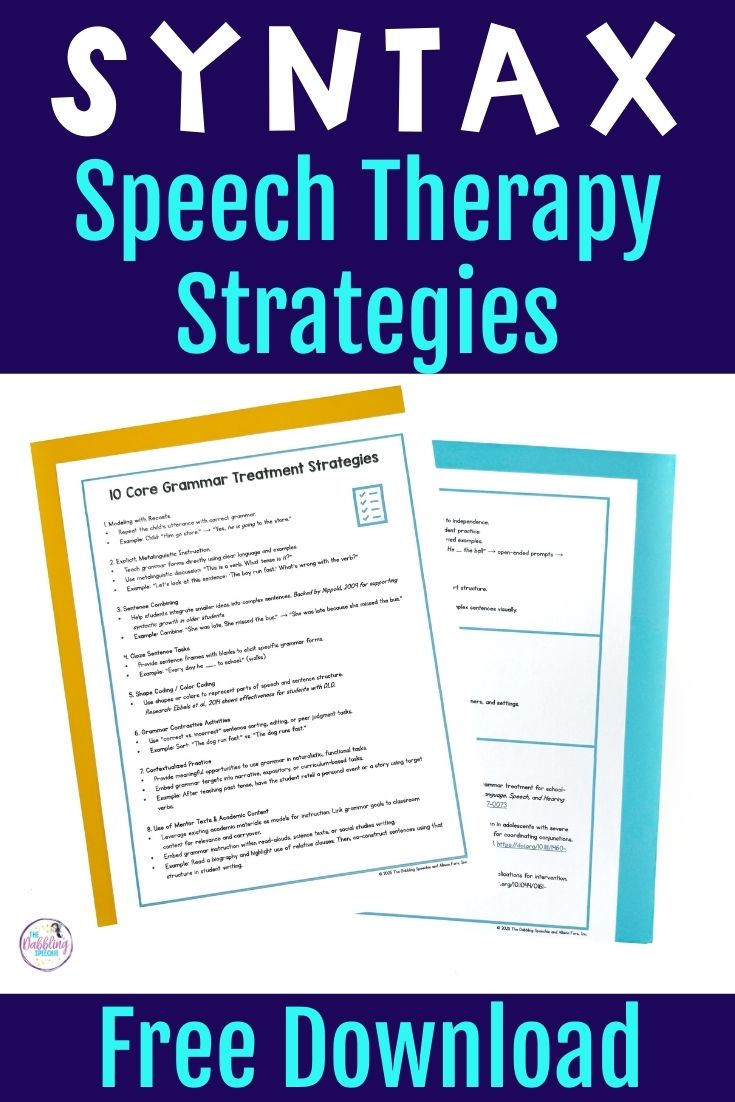
When you’re juggling a full caseload, it’s easy to forget the little things that make grammar intervention more effective. That’s why Allison Fors and I created a Grammar Speech Therapy Strategies Cheat Sheet you can download for free. Work on syntax speech therapy goals without stressing about what strategies you can use in real time.
This quick reference guide is packed with evidence-based strategies you can use with students from pre-K through high school. Keep it on hand when you’re lesson planning, or use it during sessions as a reminder of strategies you may not have tried in a while.
To help make syntax speech therapy intervention easier, here are some tools and resources to figure out where to start or how to teach syntax to your students:
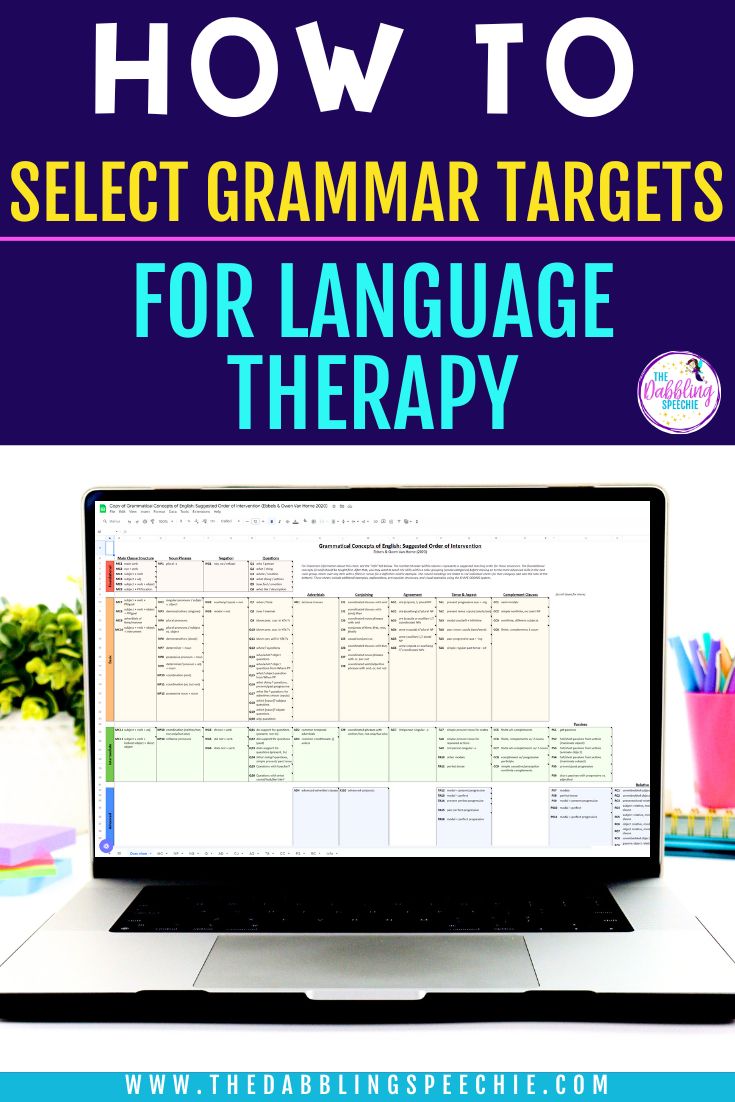
1. The Free Grammar Guide from The Informed SLP helps you figure out a starting point in therapy based on the skills your student is exhibiting. After conducting an assessment and gathering an informal language sample or probing for morphemes and sentence structures, you can determine the order or skills to target. It has foundational grammatical concepts, basic, intermediate and advanced, organized with some explanations of additional skills a child may need before working on a certain grammar structure. It’s super helpful!
2. Story Grammar Marker by Mind Wing Concepts helps you support syntax speech therapy growth while working on narrative language skills. With the visual scaffold for the narrative elements, students can organize their thoughts into longer, more complex sentences. With scaffolding, you can guide them to expand their language while story retelling by adding temporal clauses, using causal clauses, and relative clauses. By working on syntax in speech therapy with a conceptualized approach instead of just doing grammar worksheets, students can apply the syntactical rules to a natural language activity such as storytelling.
In the Themed Therapy SLP membership, we provide book cheat sheets and book companions for different themes so you can work on contextualized instruction using literacy!
3. Colourful Semantics is a resource designed to help students develop their spoken and written language skills by coding sentences with color, symbols, and signs. This approach teaches students to understand question words, expand their vocabulary, and increase sentence complexity, ultimately carrying these skills over into their writing. If you’re looking for a language therapy resource that provides a systematic outline of what to teach, this is a great fit. Plus, if you have students with both vocabulary and syntax speech therapy areas of need, you can use this resource to work on both areas at the same time.
Struggling to know which grammar goals to target—or how to actually move the needle with your students?
Allison Fors and I are breaking it all down in a jam-packed 1.5-hour training designed to take the guesswork out of grammar intervention for students with language impairments.
Here’s what you’ll walk away with:
✔ Practical strategies for three tricky syntactic structures that often hold students back
✔ Therapy ideas you can use right away (no extra prep needed)
✔ Clear guidance on which grammar goals to target when students feel “stuck”
✔ Confidence that your therapy is supporting classroom success—not just isolated speech goals
👉 Join us and walk into your next session with a clear plan for grammar intervention.
4. Shape codingTM is a grammar speech therapy tool designed by Dr. Susan Ebbels to visually show the rules for spoken and written grammar, specifically for school-aged children. Using shapes and colors, it visually shows how words and phrases combine into different sentence structures. For students with syntax speech therapy goals, this can be a great tool for teaching grammar concepts. Primarily, it is used for school-aged students with language impairments, but it has also been used with younger children, children with hearing impairment, and children with Down syndrome.
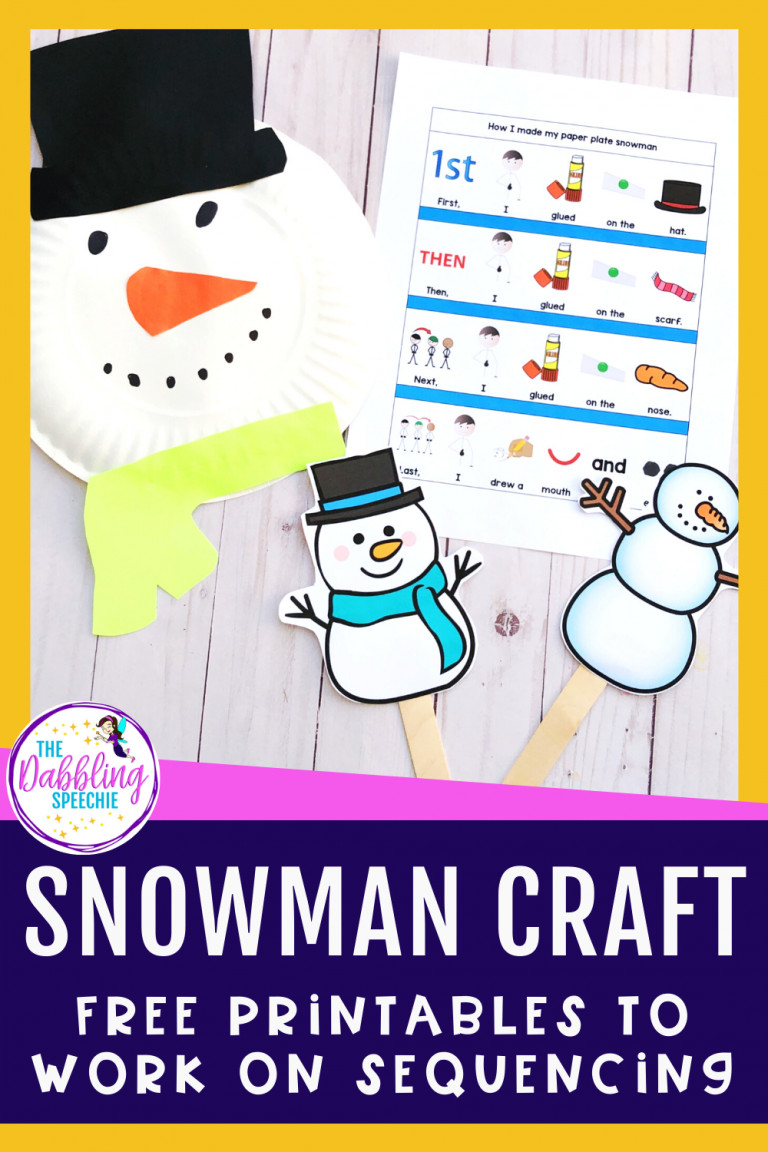
5. Another versatile tool for targeting syntax is sequencing picture cards. These cards let you present short story events in order, which creates a natural context for students to practice more advanced sentence structures.
You can use sequencing picture cards to work on:
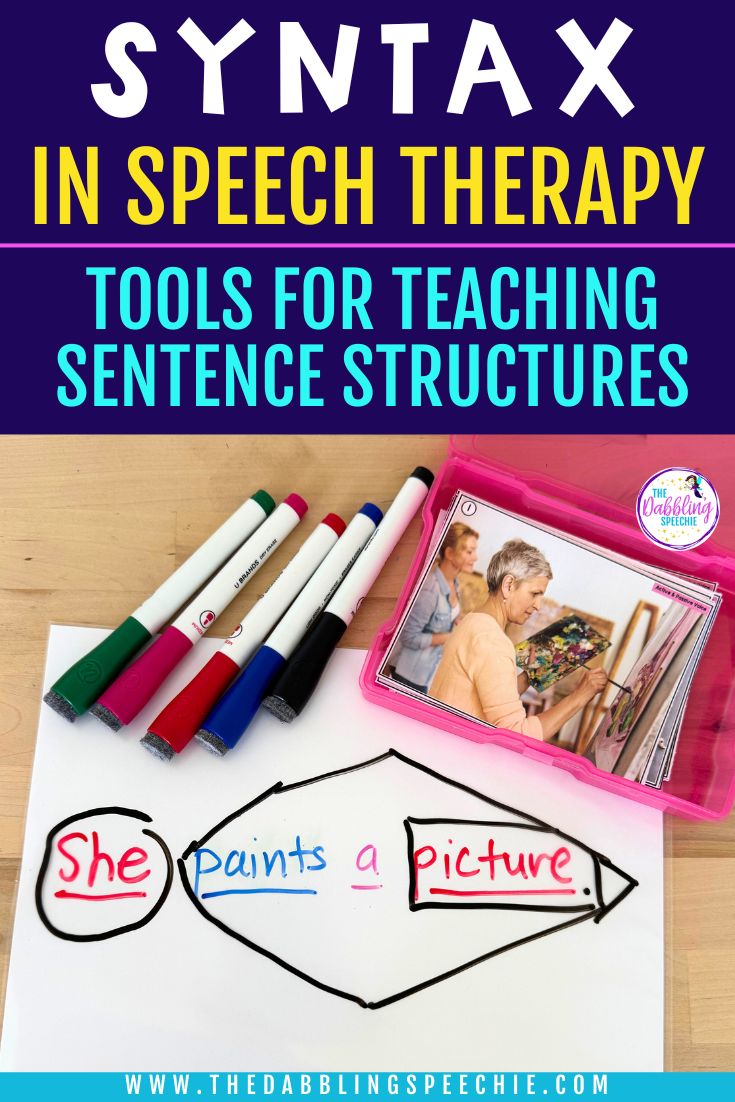
By sequencing the events, students are encouraged to combine ideas into longer, more complex sentences instead of sticking with short, simple ones. We provide themed sequencing short stories in the Themed Therapy SLP membership.
👉 Here’s an affordable set on Amazon you can check out: Sequencing Picture Cards by Spark Innovations.
Learn how to work on syntax speech therapy goals in your language sessions using these informal assessment tools:

6. If you need tools for assessment and progress monitoring, using SLAM cards (free for preschool through high school age) can help you confidently decide what syntax structure to target next with your students. SLAM cards are great for collecting language samples and tracking a student’s growth with complex sentences.
7. The SUGAR language sampling tool is a great tool to use if you need to do a quick, informal language sample. Not only can it provide a mean length of utterance (MLU), but you can also analyze for sentence complexity with clauses, conjunctions, or relative clauses during natural conversation. What’s so convenient is that it is quick to give and measure, plus it is free!
Targeting syntax in speech therapy doesn’t have to feel overwhelming. By using tools like the Grammar Guide, Shape Coding, Colorful Semantics, sequencing cards, and language sample analysis with SUGAR, you can support students in moving from simple sentences to more complex structures that boost both oral and written communication.
Remember, syntax growth is about more than grammar—it’s about giving students the language skills they need to succeed in reading comprehension, writing, storytelling, and academics.
If you’d like step-by-step guidance on what to target first and how to build toward complex sentences, join me for the Advanced Grammar Webinar happening May 27th. You’ll leave with evidence-based strategies and practical therapy ideas you can use right away.