
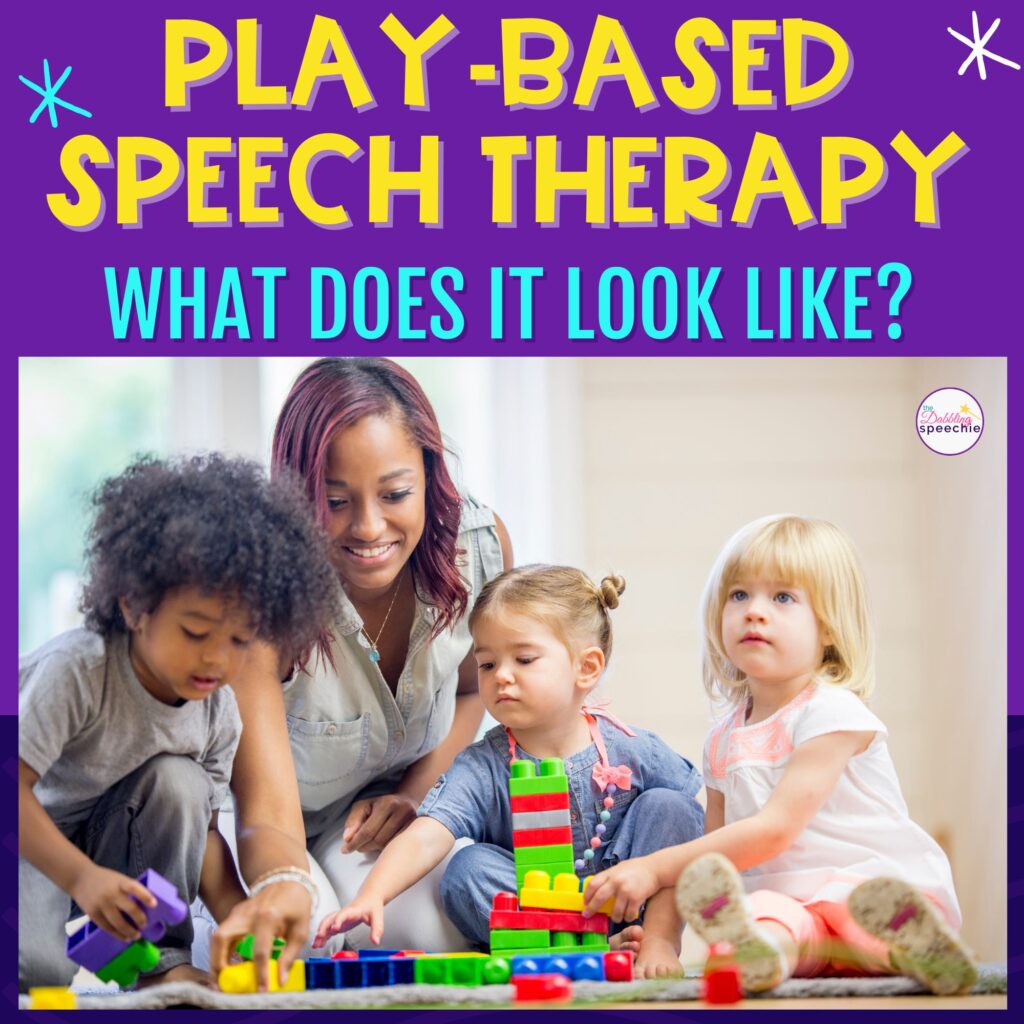
Play-based speech therapy is an approach where children learn speech and language skills through meaningful play instead of worksheets or isolated drills. While it may look simple on the surface, play-based therapy is intentional, goal-driven, and highly effective when used with purpose.
But what does play-based speech therapy actually look like in a real session? And how do you make sure you’re targeting goals, not just “playing”?
In thisblog post, I’ll break down what play-based speech therapy looks like in practice, why it works, and how you can use play to support speech and language goals across ages and settings. Best part? You can use play-based lessons with minimal prep or burn yourself out.
In this blog post, I’m breaking down:
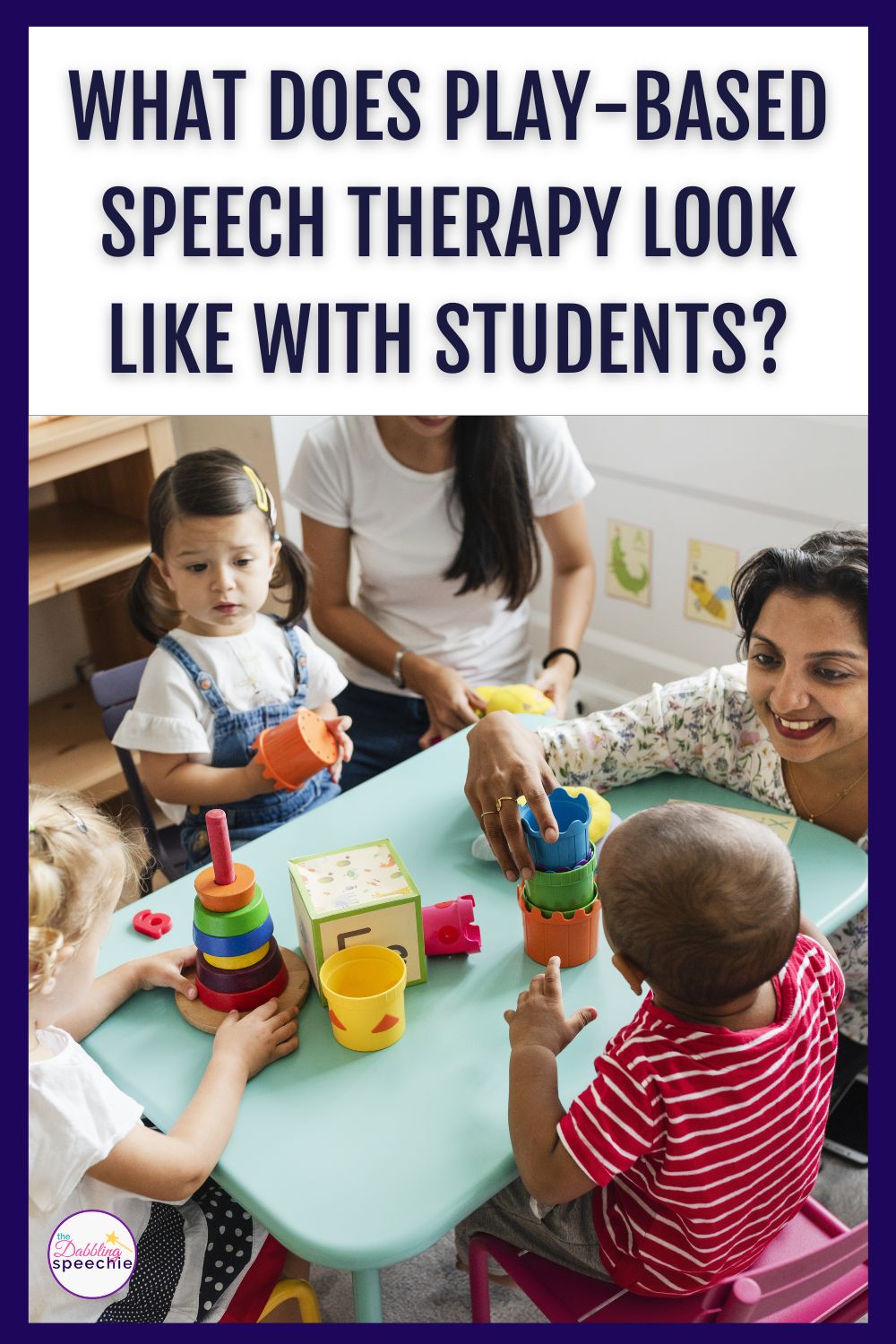
Play-based speech therapy is an approach where a speech-language pathologist (SLP) plans speech and language goals around play activities and motivating toys. Instead of separating therapy from play, the SLP intentionally creates play opportunities that encourage the child to practice target skills while engaging with materials aligned with their interests.
When therapy is built around play, children are naturally more motivated to engage and communicate. Play-based therapy can help increase attention, support positive interactions, and create meaningful opportunities to work on speech and language goals in a natural setting.
Through play, children also learn important social skills, such as turn-taking, joint attention, cause-effect, and problem-solving. Because these skills are practiced in real-life play routines, children are often better able to make connections, remember what they are learning, and carry those skills over outside of the therapy room.
Want a simple way to start implementing play-based speech therapy without overthinking it?
I put together a practical guide that breaks down types of play, stages of play, and tips for using play intentionally in therapy sessions.
Play-based speech therapy can support many different types of play, depending on a child’s developmental level, interests, and goals. Understanding these types of play helps SLPs choose materials and activities that feel meaningful while still supporting speech and language development.
This type of play involves using the senses to learn about new objects. When a child is shaking, dumping, throwing, mouthing, or smelling items, they are exploring how materials feel, sound, and move.
Functional play focuses on learning how common objects work and how they are typically used. Examples include pushing a toy car, feeding a doll, or stacking cups.
Construction play involves building or creating something using objects. This might include stacking blocks, putting together puzzles, or building structures with toys or loose parts.
This type of play includes board games or structured games that have a clear set of rules. These activities support turn-taking, following directions, and problem-solving.
Outdoor and movement play includes activities that involve physical movement, such as running, climbing, throwing, or navigating playground equipment. These activities can be motivating and support language, regulation, and social interaction.
Pretend play involves acting out everyday routines or imaginary scenarios. Examples include playing house, pretending to cook, or acting out roles like doctor or teacher. This type of play is especially rich for language development.
Play-based speech therapy works because it builds learning into activities that are meaningful and motivating for children. When children are engaged in play, they are more likely to participate, communicate, and stay involved throughout the session.
Play creates natural opportunities for repetition without it feeling like practice or like they have to perform. Have you ever frozen up when someone called on you on the spot to answer a question in a big speech therapy PD event? But when you were asked to lead a table talk with your team members on a question, you spoke freely. Why? Because having a conversation with your colleagues was natural and familiar.
Many kids love to play and do not typically have people pulling out flashcards and drills at home. That type of practice is not as natural as driving a train around a track or rolling a ball across the room.
Don’t get me wrong, flashcards, worksheets, drills and table-top activities have there place in therapy. They are very effective. I use a combination of materials, but my favorite is play-based learning. Not only does play-based learning connect so many other skills besides language (think fine and gross motor, perspective taking, predicting, social communication) it also supports carryover into the home and community so your students are applying what they learn outside of the speech session!
One of the best parts of why play-based speech therapy works is that you can follow the child’s lead with toys and activities that motivate them. You can introduce new toys or games to see what they gravitate toward, but the child gets to help steer the session. This often means less intense lesson planning for you.That idea can feel scary at first, especially if you are used to walking into sessions with everything planned out. That is why I use my toy companion cheat sheets to quickly come up with targets and activity ideas on the spot without draining my mental energy. If you want that kind of support, you can grab the set on TPT or in my website shop.
Children move through different stages of play as they develop, and understanding these stages can help SLPs choose activities that are developmentally appropriate and engaging. Not every child will move through these stages at the same pace, but they provide a helpful framework when planning play-based speech therapy sessions.
Understanding both the types and stages of play can help SLPs meet children where they are and choose play activities that support meaningful communication.
Play-based speech therapy can be used to target a wide range of speech and language goals. Because play naturally creates opportunities for interaction, problem-solving, and communication, it allows SLPs to work on multiple skills within the same activity while keeping sessions meaningful and engaging.

Speech sound goals can be targeted through play by embedding sound practice into games, pretend play, and interactive routines. Instead of relying only on isolated drills, children can hear and use their target sounds naturally while playing, taking turns, and communicating with others. For more play-based articulation therapy ideas, head to this blog post. I share lots of tips for setting up your sessions and a free initial G articulation flashcard set and game to use to keep kids engaged while getting high trials!
Play-based activities are ideal for teaching basic concepts such as big and little, same and different, and first and last. Spatial concepts like in, out, on, under, and next to can be targeted naturally as children move objects, build scenes, or play with toys in different ways.
Yes-no questions can be practiced naturally during play by offering choices, asking for confirmation, and responding to a child’s actions. Play routines give children meaningful reasons to answer yes or no, which helps practice feel purposeful instead of repetitive.
WH questions such as who, what, where, and why can be targeted during play as children describe actions, talk about characters, explain what is happening, and predict what might happen next. Play provides context, which helps support both comprehension and expressive language.
Play is a natural way to build vocabulary and work on categories. As children interact with toys and materials, they are exposed to new words, labels, and concepts. Categorization skills can be targeted by sorting toys, grouping items, and talking about how objects are the same or different within play routines.
Play-based speech therapy also supports sentence structure and grammar development. As children engage in play, SLPs can model and expand utterances, recast sentences, and highlight grammatical forms within meaningful interactions. For a deeper look at what grammatical skills to target, the grammar guide from The Informed SLP is a helpful reference.
Play naturally supports social communication skills such as turn-taking, joint attention, perspective taking, and problem-solving. For students working on early communication or social interaction, tools like the Communication Matrix can provide ideas for targeting communication functions within play.
Play-based therapy is also highly supportive for students who use AAC. Core words can be modeled and practiced during play as children request, comment, direct actions, and interact with others. Because play is motivating and repetitive, it creates natural opportunities for meaningful AAC use throughout the session.
Between managing attention and behavior, supporting communication, and working on IEP goals during play, sessions can feel cognitively overwhelming for clinicians. We want to maximize play-based sessions, but it can be exhausting trying to come up with relevant targets on the spot while also keeping the play moving.
That is why I created my Toy Companion Cheat Sheet Guides. Available on TPT and my website shop, these guides support a play-based approach to speech therapy by helping you quickly identify targets for 45 popular toys and games used with preschool and elementary students.
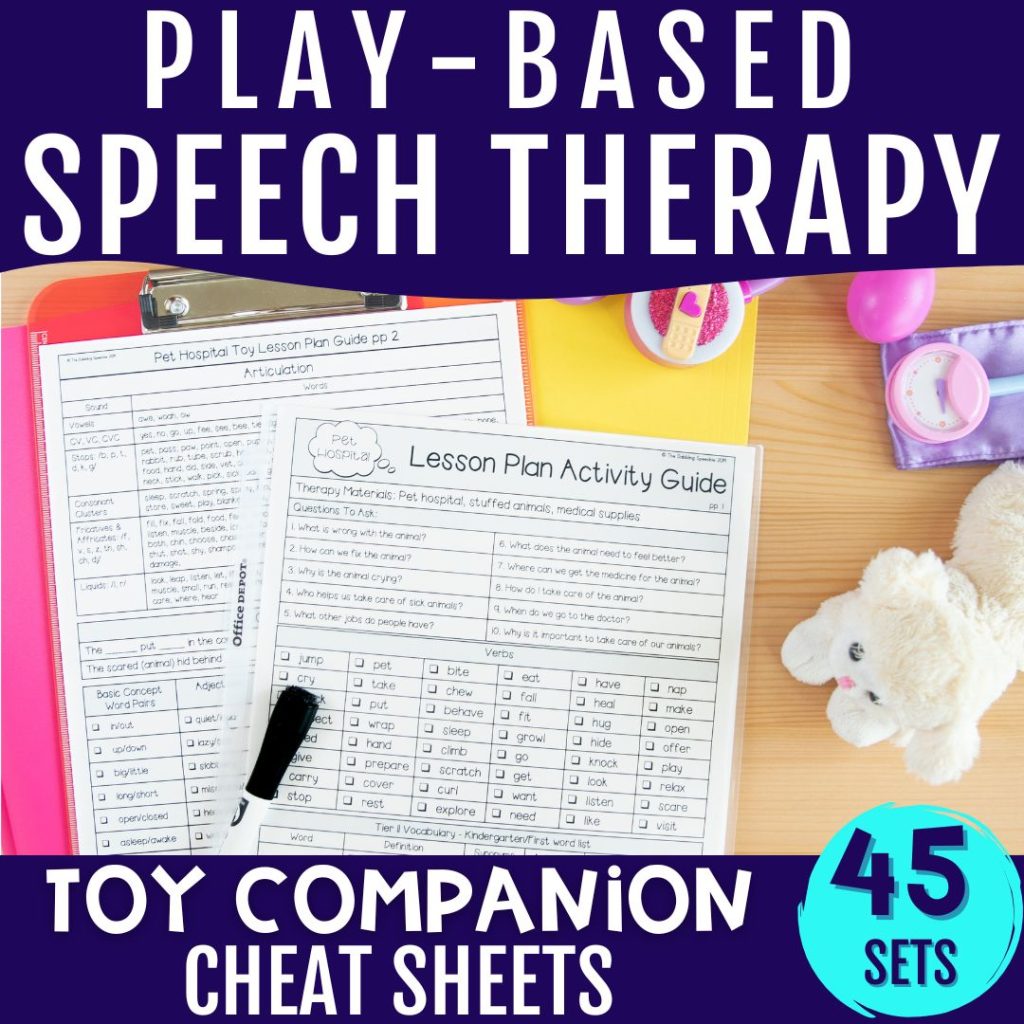
Each toy companion includes:
That is a lot of skills in one place. The goal is to help you walk into sessions feeling prepared without spending hours lesson planning. These cheat sheets make it easier to follow a child’s lead during play while still targeting meaningful goals.
They can also be used to support parents and teachers by showing them how to use toys in a more functional, communication-rich way outside of speech sessions.
If you need support planning play-based therapy quickly and confidently, these cheat sheets can help you feel ready in minutes.
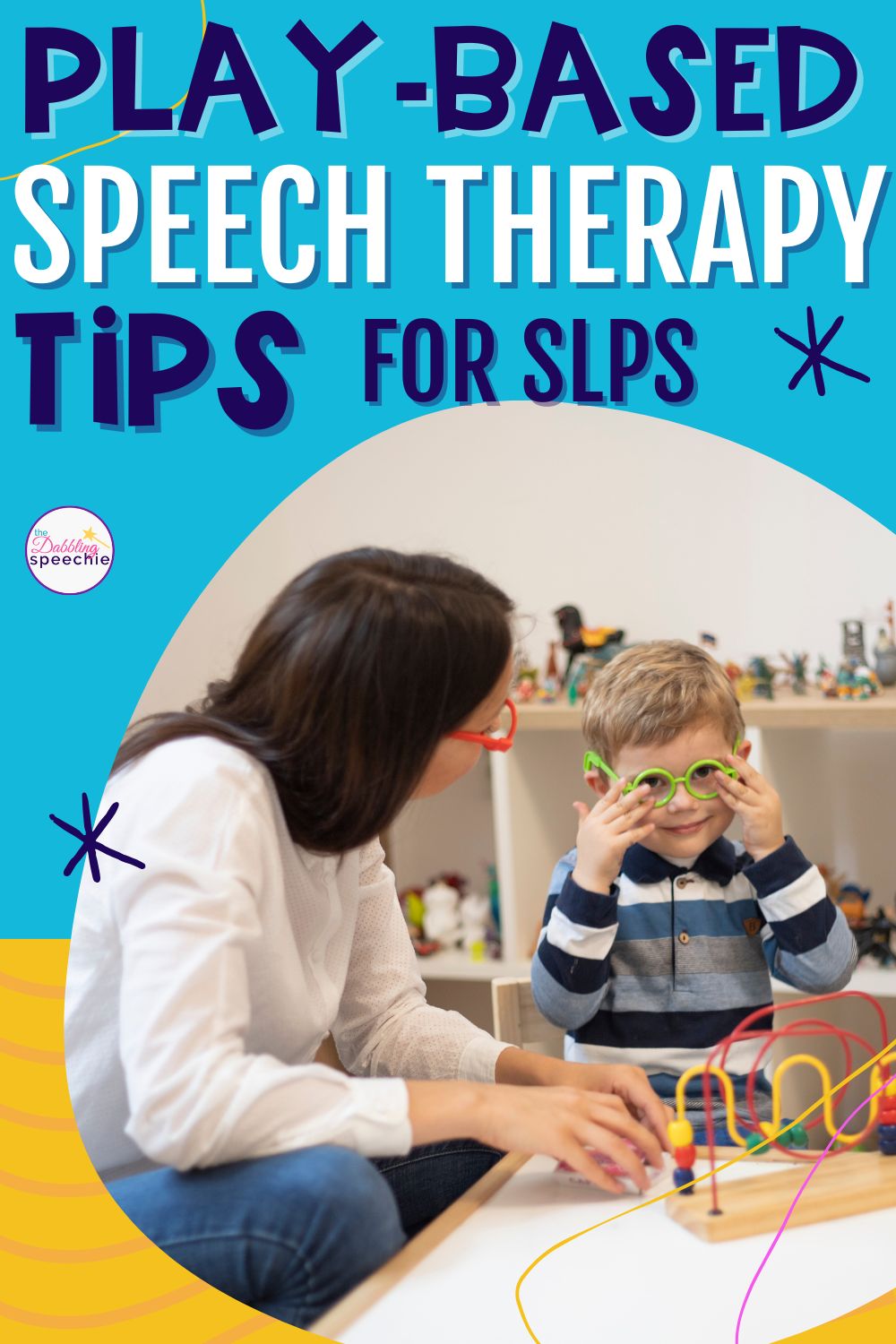
When using a play-based approach, it is important to let the child take the lead as much as possible while still keeping target goals in mind. Play should feel natural and engaging, not overly clinician-directed.
Try to avoid commands such as “say this” during play. When too many demands are placed on students, it can take away from the play aspect of therapy. Instead, model a word or phrase and allow five to ten seconds of wait time to see if the child initiates a comment or question.
Choose toys and materials that are relevant and interesting to the child. Participation and communication often increase when the materials are motivating. This is why knowing what play stages your student is developing will help you pick out toys and activities that are at their level.
If a toy or activity is engaging, use it across more than one session. This can reduce lesson planning time and increase meaningful practice with targeted skills.
Offering two toy or play options during a session allows the child to help make decisions and feel more invested in the activity. Toys that were not interesting in the past can also be reintroduced later, as interests often change over time.
For students who struggle with transitions, setting a timer and using visual supports can help prepare them for the end of a play activity and reduce explosive protesting behaviors.
Throughout play, model the speech and language skills you want the child to learn. This might include showing how to request a toy, demonstrating how to play with materials, or modeling new words and phrases within the activity.
One of the reasons play-based speech therapy works so well is because many toys can be adapted to target a wide range of goals. When you choose open-ended toys, it becomes easier to plan sessions that support language, speech, and communication without starting from scratch each time.
I have several blog posts that break down how to use specific toys in speech therapy and adapt them for different goals. These examples show how one toy can support many skills across sessions:
And many other toys for preschool and early elementary that you can add to your therapy stash!
These posts are helpful if you want concrete examples of how to turn everyday toys into intentional play-based learning opportunities.
When reflecting on my own speech therapy sessions, I have realized that I do not always use a purely traditional play-based approach. I often use a modified play-based approach, which is not a bad thing.
A traditional play-based approach typically means the SLP follows the child’s lead during play and infuses speech and language goals naturally into whatever the child chooses to do. The child drives the activity, and the clinician models language, expands utterances, recasts responses, and creates communication opportunities within the child’s play.
A modified play-based approach still uses play as the foundation of the session, but the SLP may guide the activity more intentionally based on the child’s goals. This might include bringing in specific toys or games, setting up the play environment, or directing how the play unfolds to support targeted skill practice.
For example, when working with students who have speech sound disorders, we often need to achieve a high number of practice trials. In those cases, the SLP may tell the child what to say, ask them to repeat words, or structure the play so that speech sound practice occurs frequently. A child might practice articulation or phonology targets while playing with a farmhouse or animal set, but the adult is guiding the interaction to ensure enough repetitions.

On the other hand, when the goal is to build verbs, vocabulary, or early language skills, the SLP may take a more child-led approach. If a child is playing with a farm and decides to line all the animals up by the pond, the clinician can model language around what the child is doing, emphasize key words, pause to allow opportunities for communication, and recast the child’s responses without requiring them to repeat words.
Both approaches are valid and effective. The key is understanding the difference and choosing the level of structure based on the child’s needs, goals, and stage of development. Play-based speech therapy does not have to be all or nothing. It can be flexible, responsive, and intentional.
If you are ready to put a play-based approach into action and want support with planning, these resources can help you get started without overthinking your sessions.
You can also grab the Play-Based Speech Therapy Starter Guide mentioned earlier in this post for a simple way to review types of play, stages of play, and practical tips for implementing play-based therapy.
Play-based speech therapy is not about choosing one “right” way to run a session. It is about being intentional with play, understanding your student’s goals, and using the level of structure that best supports their learning. Whether you are following a child’s lead, using a modified play-based approach, or blending play with more structured practice, the goal is meaningful communication that carries over beyond the speech room. When play is used thoughtfully, it can support a wide range of speech and language skills while making therapy more engaging and sustainable for both you and your students.
If you are looking for support with planning, ideas, or tools to help you feel confident using play in your sessions, the resources shared in this post are designed to meet you where you are and make play-based therapy easier to implement.
You can also grab the Play-Based Speech Therapy Starter Guide mentioned earlier in this post for a simple way to review types of play, stages of play, and practical tips for implementing play-based therapy.