

Brain Breaks for speech and language assessments can be helpful for many reasons. I use brain breaks during my preschool and elementary speech and language assessments a lot. “Brain break” is a fancy word for taking I need/want valid results of the student’s abilities, so brain breaks provides an opportunity for the student to re-focus their attention as well as keep them motivated during the assessment.

We all know that SLP’s are on limited time and it’s easy to want to just push through the assessment, but I keep seeing statistics and research that says our brains perform much better when we have movement breaks! Quite frankly, testing a student for too long makes me super cranky, so incorporating brain breaks has been helpful for my focus and motivation.
I included a link to a youtube video, so you can see some examples of how brain breaks are implemented in the classroom setting.
Here are some quick and easy brain breaks that don’t take up a ton of time, but still give the student a small break! (amazon affiliate links included for your convenience)
I use a timer on my phone to help keep the brain break short as well as give the student warning about when we are going to transition back into testing.
You can also use a Time Timer or Learning Resources Time Tracker Mini
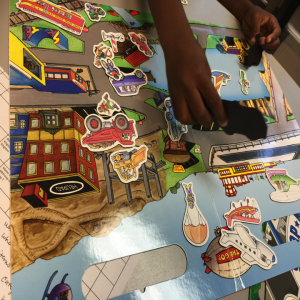 Create A Scene Magnetic Boards are a great activity that you can have students do as a brain break. I try to have the student stand while completing the task or I have them select a magnet one at a time and create a scene on my white board. This way they have to walk to and from the table each time they want a new magnet. After they finish putting the scene together, you can ask them wh-questions, create sentences or story about the scene all the while taking some informal data about their speech development, grammar and comprehension!

I use these Party Favors 6/Pkg-Suction Cup Balls to play a throwing game on the dry erase white board. I draw a target or a themed game scene like a baseball field and assign different point amounts if you get the suction ball on certain areas. The child gets movement from throwing the ball and walking to retrieve the suction ball after each throw. We play for 3-5 minutes before transitioning back to the assessments.

Taking a walk is a great brain break….I recently did this with one of my older students because I needed a break! This is when I did my informal conversational sample. Grab a tally clicker, record the conversation on your phone to count speech dysfluencies or describe their social skills interaction during this conversation time.
Watch a youtube video that has movement or song/dance steps. You can do the video along with the student! I find that I need movement just as much as my students do. Below are some links to other videos that provide movement.
Do you use brain break for your speech and language assessments? What works for you?