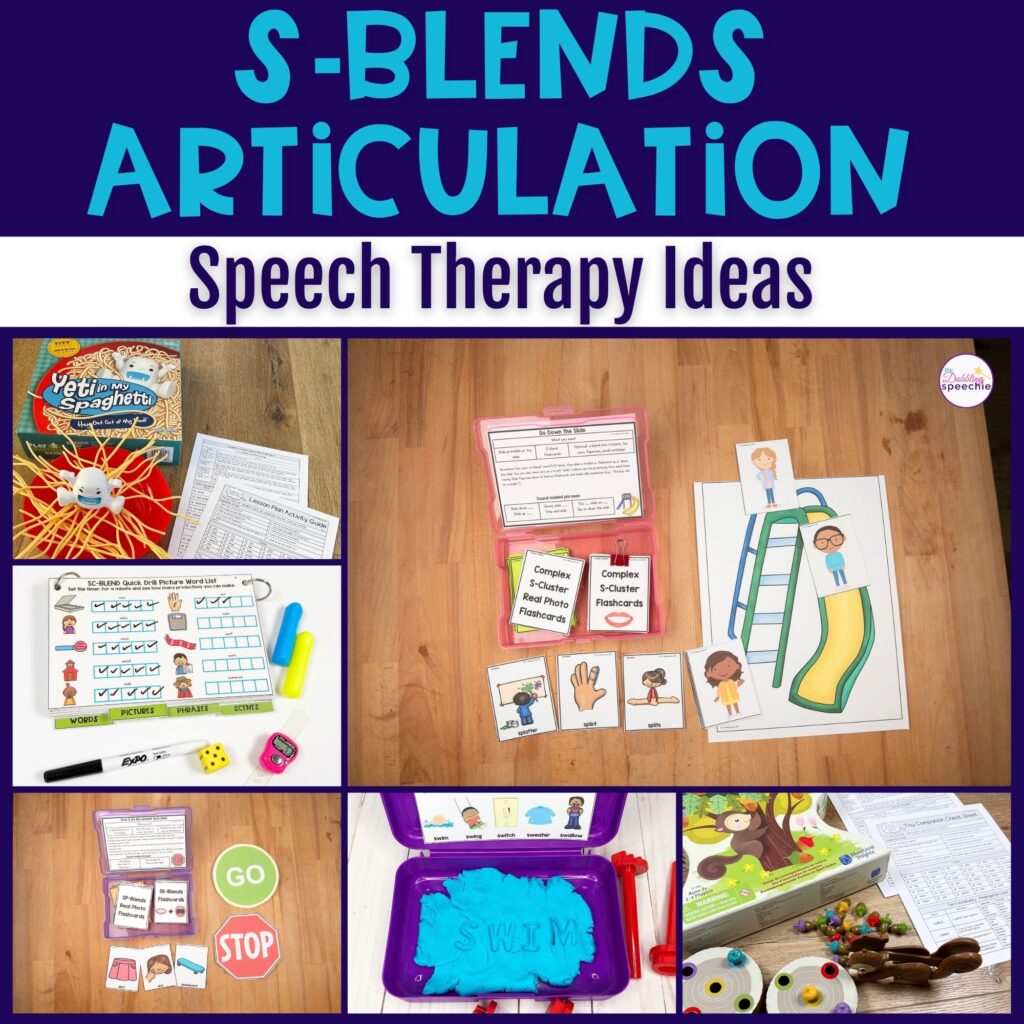
If you are looking for s blends articulation activities and ideas, you have probably noticed that what works in drills does not always carry over into conversation. Your students might be able to produce s blends in isolation or at the word level, but once you move into sentences, that /s/ sound disappears.
In this post, I am sharing a step-by-step plan for teaching s blends in speech therapy. You will find articulation strategies, activity ideas, and practical ways to help your students carry over their s-blends sounds beyond drills so they can use them more consistently in connected speech.
Many students with s-blend errors demonstrate a phonological pattern, such as cluster reduction, which may mean they need more than a traditional articulation approach.
If you want a breakdown of how to use a traditional articulation approach in your sessions, you can read more here.
When working on s-blends, it is important to think beyond just practice at the word level. Many students who struggle with s-blends demonstrate a phonological pattern, such as cluster reduction, which often requires an approach different from a traditional articulation model.
Before jumping into activities, consider the type of support your student needs to choose the most effective therapy approach.
Minimal pairs are a great option when students are omitting the /s/ sound in blends (for example, saying “top” instead of “stop”). This approach helps students hear the difference between the correct and incorrect production and understand how meaning changes when the /s/ is left out.
You can use simple word pairs like:
This is an effective way to build awareness and encourage self-correction during practice. It is an ideal therapy approach for students with mild to moderate consistent phonological errors. Minimal pairs are one of the most effective approaches for treating s-blends when cluster reduction is present.
If a student is consistently reducing clusters across many words, the cycles approach can be a helpful framework. Instead of expecting mastery right away, you target s-blends for a short period of time, then move on to a new phonological process, and then cycle back later to working on s-blends.
This approach works well for students with multiple phonological processes and allows repeated exposure without pressure to be perfect. Students who are very difficult to understand because they have many phonological errors would benefit from this approach. For example, if you have students who exhibit gliding, fronting, final consonant deletion, and cluster reduction, they would be good candidates for this approach.
The cycles approach is commonly used in speech therapy for students with multiple phonological processes, including s-blend sound errors.
For students who are ready for a challenge, the complexity approach can be used to target more difficult s-blends first. Teaching more complex clusters may lead to generalization across simpler ones.
For example, working on a blend like /str/ may help improve the production of simpler s-blends like /st/ over time. SLPath has many great resources for implementing this approach and for getting trained on how to use it with students.
Many students need support in hearing and understanding s-blends before they can consistently produce them.
You can build these skills by:
These activities help students become more aware of the sound structure of words, which supports more accurate production during speech tasks. The digital speech folders for s-blends articulation practice have Google Slides for auditory discrimination and phonological awareness.
To help you determine which therapy approach is best for your students with speech sound disorders, The Informed SLP offers a free cheat sheet that breaks down how to implement the approach, the frequency of therapy sessions, how many trials to achieve each session, and research on the approach.
Once you have identified the right approach, you can use targeted s blend articulation and phonology activities and games to help your students practice and generalize their skills.
S blend errors in speech therapy often involve deleting the /s/ sound in a consonant cluster, which is commonly referred to as cluster reduction. For students exhibiting s-blend speech sound errors, you want to teach the elicitation of the /s/ sound. If the child already has the /s/ sound established in other words or contexts, the issue may not be motor planning but rather coordination of the /s/ with another consonant, such as “spin.”
So, instead, they reduce “spin” to “pin.” Or, they may not even hear that they are deleting the /s/ sound and do not realize that by deleting the /s/ they are creating an entirely new word, which makes it difficult for communication partners to understand what the child is trying to say.
When you are working at the isolation or syllable levels, incorporating visuals, auditory discrimination, and segmentation strategies will help with establishing the /s/ sound. As I wrote above, minimal pairs can be a great approach for determining if the child can auditorily discriminate between two words and can help them understand the linguistic differences when you delete the /s/ sound.
Using a cycles approach relies on auditory bombardment and segmenting the sounds to help with elicitation. Similarly, a complexity approach uses modeling and sound segmentation to help students put three s-blend clusters together in a production.
Below are some tools and resources that will help you with teaching the /s/ consonant and how to segment it with other consonants:
Many students with s-blends need support with both sound awareness and sound coordination. Once students can produce and segment the /s/ sound, you can begin moving into word-level s-blends articulation and phonology practice using structured activities and games.
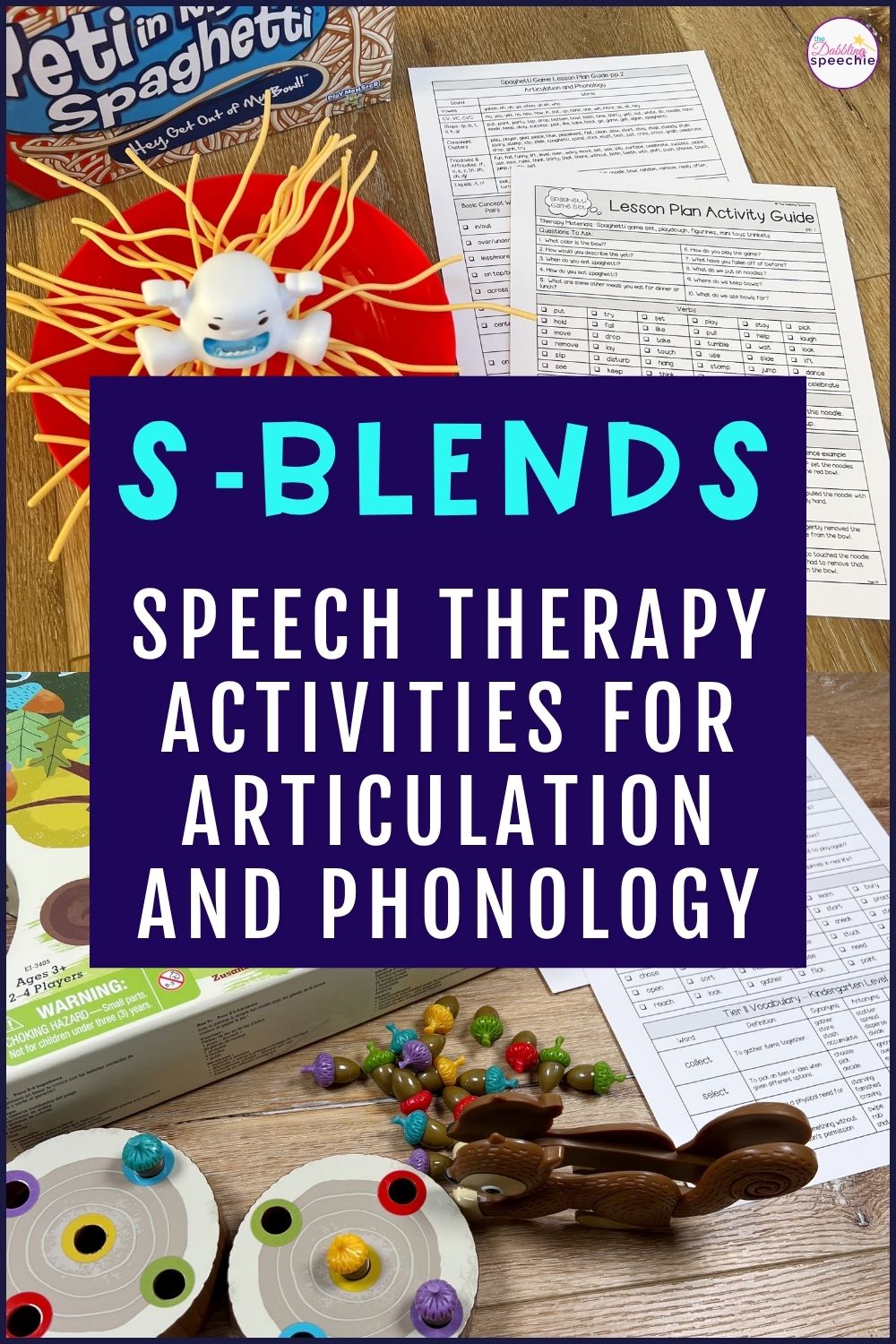
Auditory bombardment is a key strategy in Barbara Hodson’s cycles approach to help students hear correct s-blend productions before moving into targeted word practice during the session. Typically, at the beginning of a session, you would review the previous session’s word cards. Then, provide auditory stimulation of the s-blends by reading a list of words that contain the target pattern for the session. The child doesn’t have to repeat or do anything; they just need to listen to the s-blend words. Here are some resources to help you with auditory bombardment with s-blends:
Once students have had repeated exposure through auditory bombardment, you can begin targeting s-blends at the word level with structured activities and games.
Once students can produce and segment the /s/ sound with another consonant, it is important to provide engaging practice so they can build accuracy at the word and sentence levels.
You can use a mix of play-based and structured activities depending on your students’ needs and goals.
If you are looking for more play-based articulation therapy ideas, I share ways to use toys, pretend play activities, and play-based learning to work on speech sounds in this blog post.
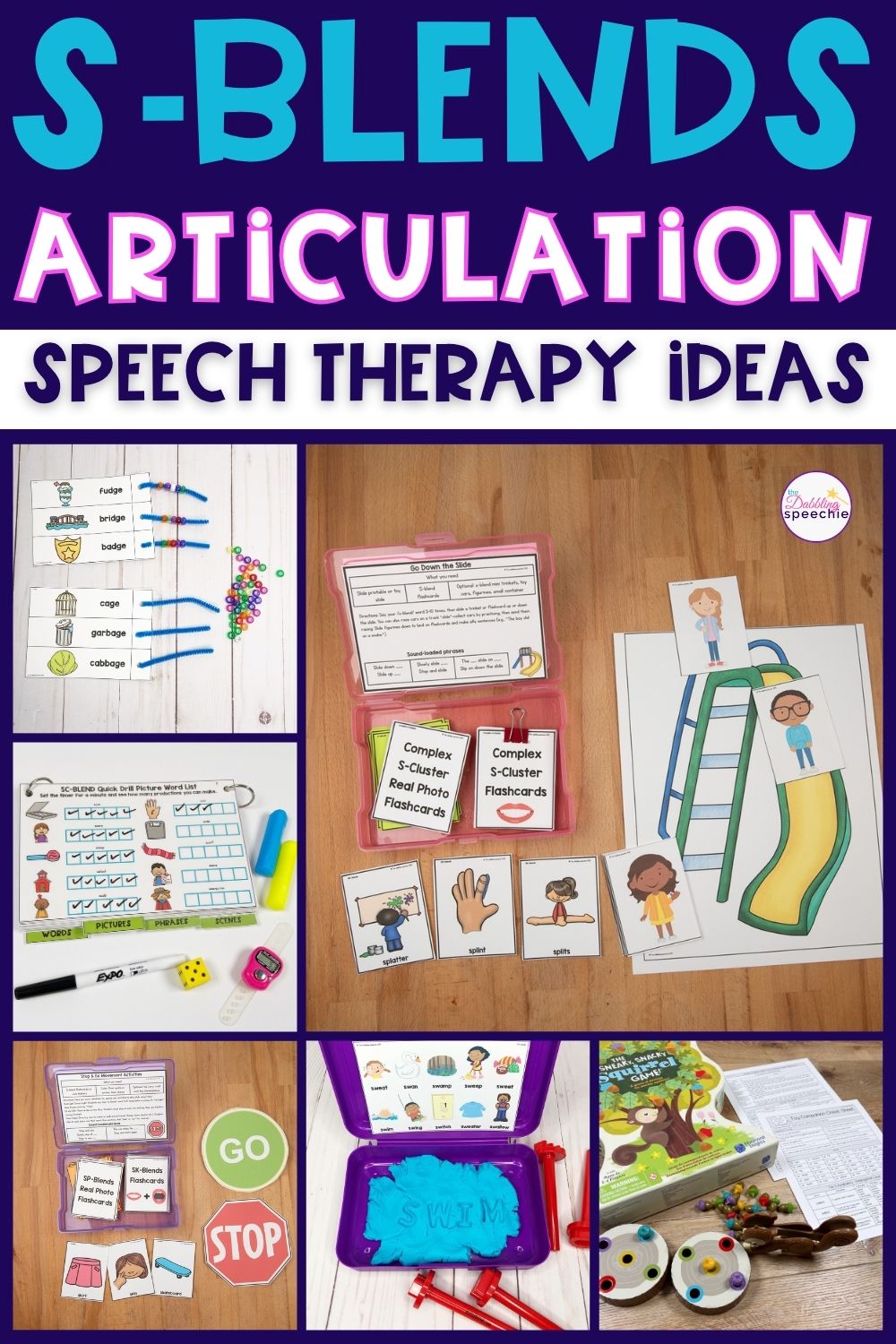
Using games in speech therapy is one of the easiest ways to increase engagement while achieving high trial counts of s-blends. Games allow students to practice repeatedly without feeling like they are doing drill work.
One easy way to make sure you have high trials is to have games with sound-loaded words or phrases they can use every turn. My best s-blend articulation games are shared in this blog post, with s-blend word lists for those games.
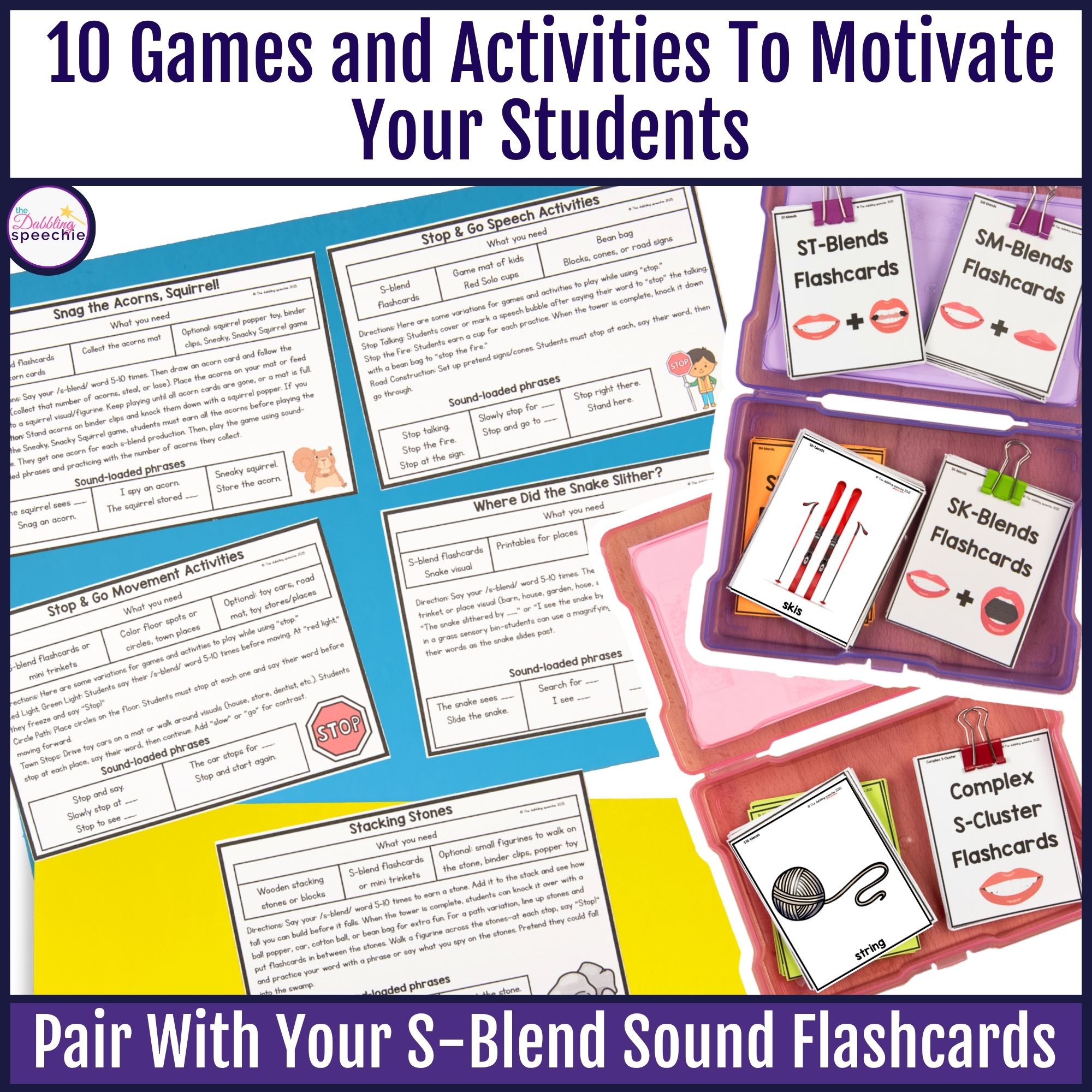
For easy, quick drill games, here are some motivating ones you can use with s-blends articulation flashcards:
If you are ready to move your students from segmenting sounds into accurate S-blend production at the word level, having structured, high-trial practice makes a big difference.
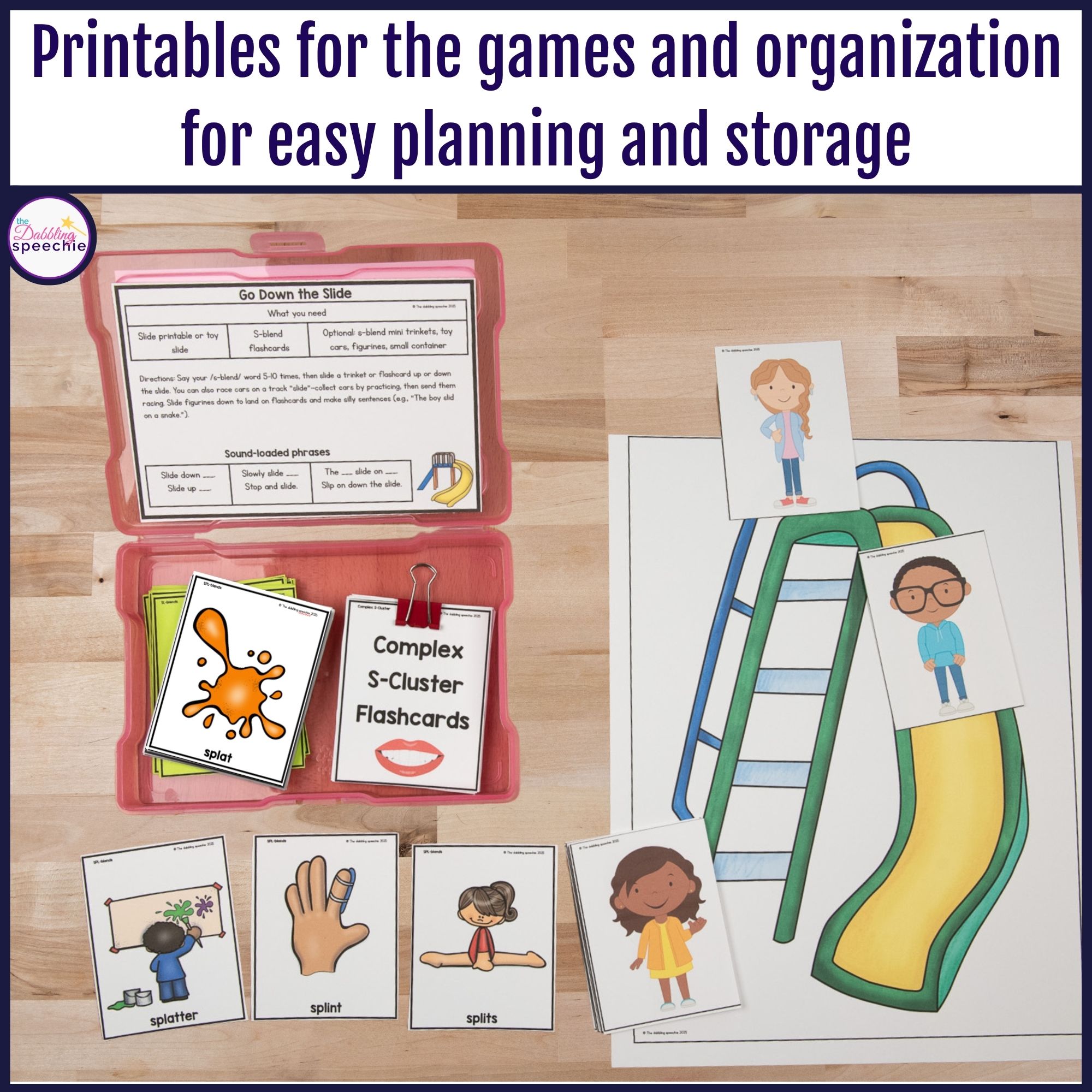
This S-blends articulation flashcards and games resource is designed to help you get a lot of meaningful practice in a short amount of time while keeping students engaged.
You can use these flashcards to support students as they move from isolation into word-level S-blends while maintaining accuracy and consistency.
👉 Shop this S-blends resource on my website
👉 Prefer TpT? You can grab it here
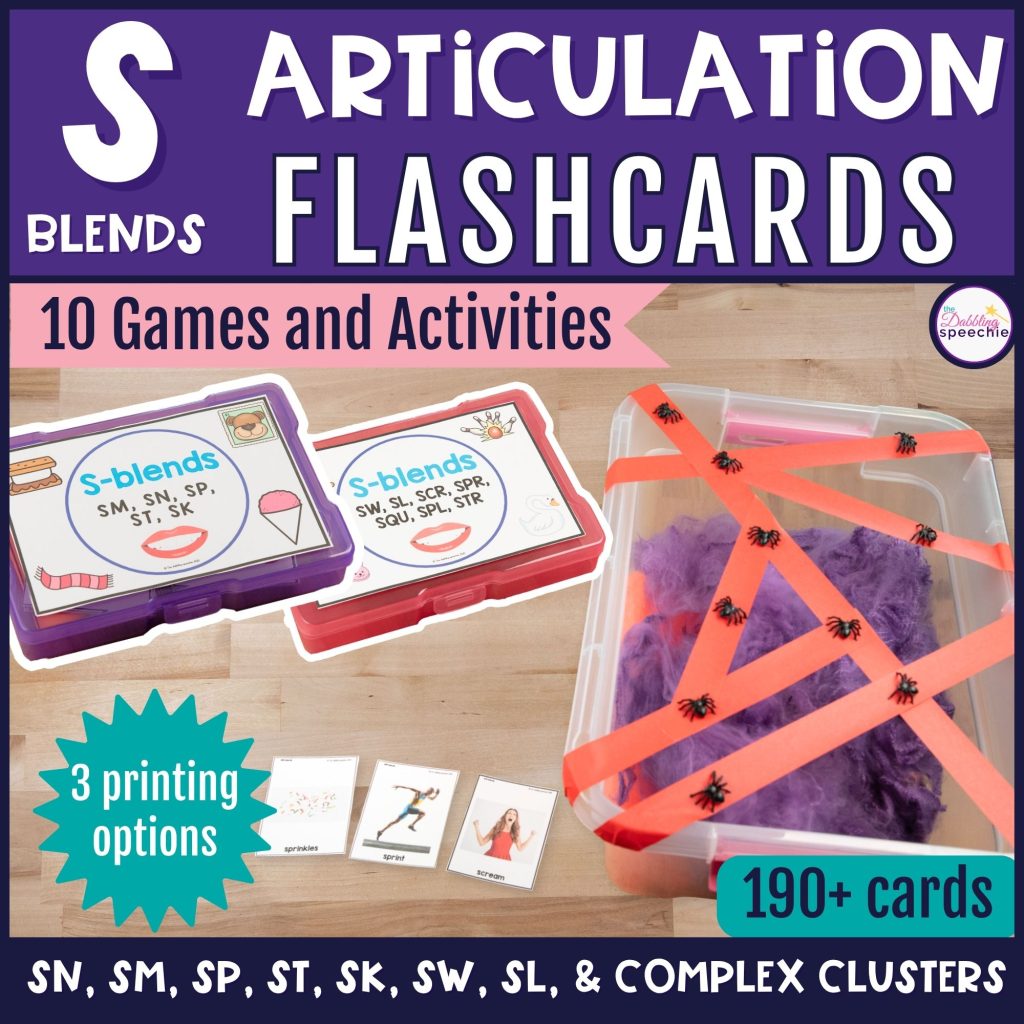
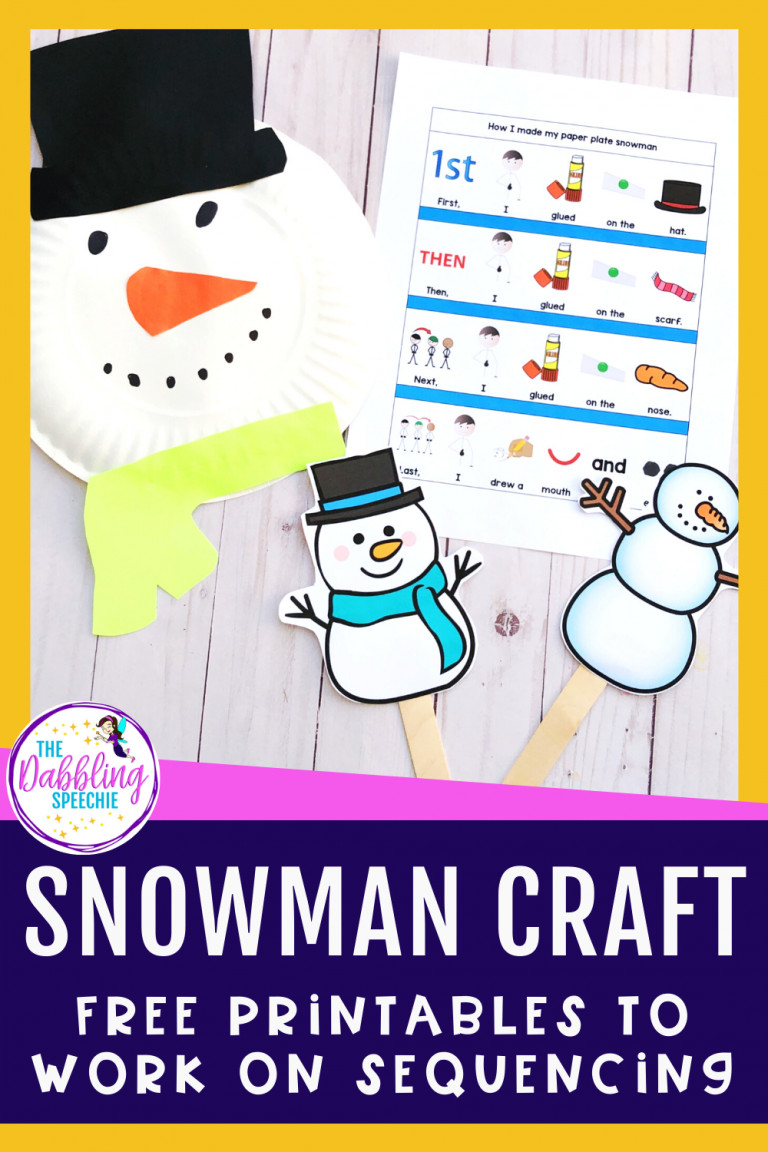
One highly effective s-blends articulation activity is using low-prep crafts. One, they keep their hands busy while you might be drilling independently with students in your group. And speech therapy crafts, once finished, can be sent home as speech homework. Or, you can put them on your bulletin board as a warm-up activity when your students walk into your room. You can easily target s-blend words at the word level while students are creating something, which helps increase repetition without feeling like drill work. Here are some of my favorite s-blends speech therapy crafts that won’t take tons of prep time and help you plan for your groups:
Once students can accurately produce s blends at the word level, the next step is helping them use those sounds in sentences. This is where many students start to lose accuracy, so providing structured and repeated practice is key.
Using sentence-level s blend articulation activities helps students build consistency while increasing the complexity of their productions.
Carrier phrases are an easy way to transition from single words to full sentences while still getting high trials.
You can use simple phrases like:
Students can fill in the blank with s-blend words such as “spoon,” “star,” or “snake.” You can also use s-blend articulation flashcards to easily swap in new target words while keeping the same sentence structure, which helps increase repetition without extra prep. This allows for repeated practice while keeping the structure predictable. Use the sound-loaded sentence strips in this resource and s-blend words to get in extra practice.
In the Themed Therapy SLP membership, we provide visual sentence strips aligned with the theme to use with mini trinkets, speech words, or flashcards. Plus, we have a speech-sound word list for each theme that includes s-blend words, so you have a list of themed words with your students’ target sound.
As your student makes more progress with carrier phrases, you can add in sound-loaded sentences to get in an extra trial every sentence:
Comparing two items with s-blends is a great way to work on both articulation and language skills.
For example:
Students can describe how the items are the same and different, which encourages longer sentences and repeated s-blend productions. Doing activities like this also aligns with common core standards and academic skills your students may need to know and utilize in class.
Creating silly sentences or alliterative s-blend phrases makes practice more engaging and memorable.
For example:
You can have students illustrate their sentences or turn them into a mini book for extra practice.
Using books is a great way to help students practice s blends in a more natural and meaningful context. Books allow students to hear repeated models of s-blend words while also working on comprehension, vocabulary, and sentence structure. They can practice the s-blend words in the story at the word, sentence, reading, or conversational level. After reading the story, practice the s-blend words or have fill-in-the-blank sentence starters that they fill in with the s-blend word.
Your students can create sentences about the pictures using the s-blend words, read the story, or retell it in their own words.
You can choose books that naturally include s-blend words, such as animals (snake, spider), space themes (star, space), or everyday routines (school). As you read, pause to point out s-blend words and have students repeat them or use them in short sentences.
Books also make it easy to target multiple goals at once. While focusing on s blends, you can also work on answering WH-questions, retelling the story, and describing characters or events. Here are a few s-blends speech therapy books you can use in your sessions:
In the Themed Therapy SLP membership, I include book cheat sheets with speech-sound word lists organized by target sound, making it easier to quickly find s-blend words within a story during your sessions.
Once students can use s-blends in structured sentences, the next step is helping them use those sounds in conversation. This is where you begin to see whether skills are truly carrying over beyond drills and structured tasks.
At this stage, the goal is to increase consistency and self-awareness of productions as students speak in longer utterances, answer questions, and share ideas.
Start with supported conversation tasks to help students feel successful while still getting repeated s-blend productions.
You can:
Teaching s-blends in speech therapy can feel challenging at first, especially when students can produce the sounds in isolation but struggle to carry them over into conversation. Having a clear plan that moves from elicitation to word-level practice, then to sentences, and finally to conversation can make a big difference in helping students build consistency.
By combining structured activities, play-based learning, and meaningful conversation tasks, you can increase repetitions while keeping your students engaged. Over time, this consistent practice helps students use s blends more naturally in their everyday communication.
What are your favorite ways to work on s blends in speech therapy? Share your ideas in the comments. I’d love to hear what’s working in your sessions!